

6 min read
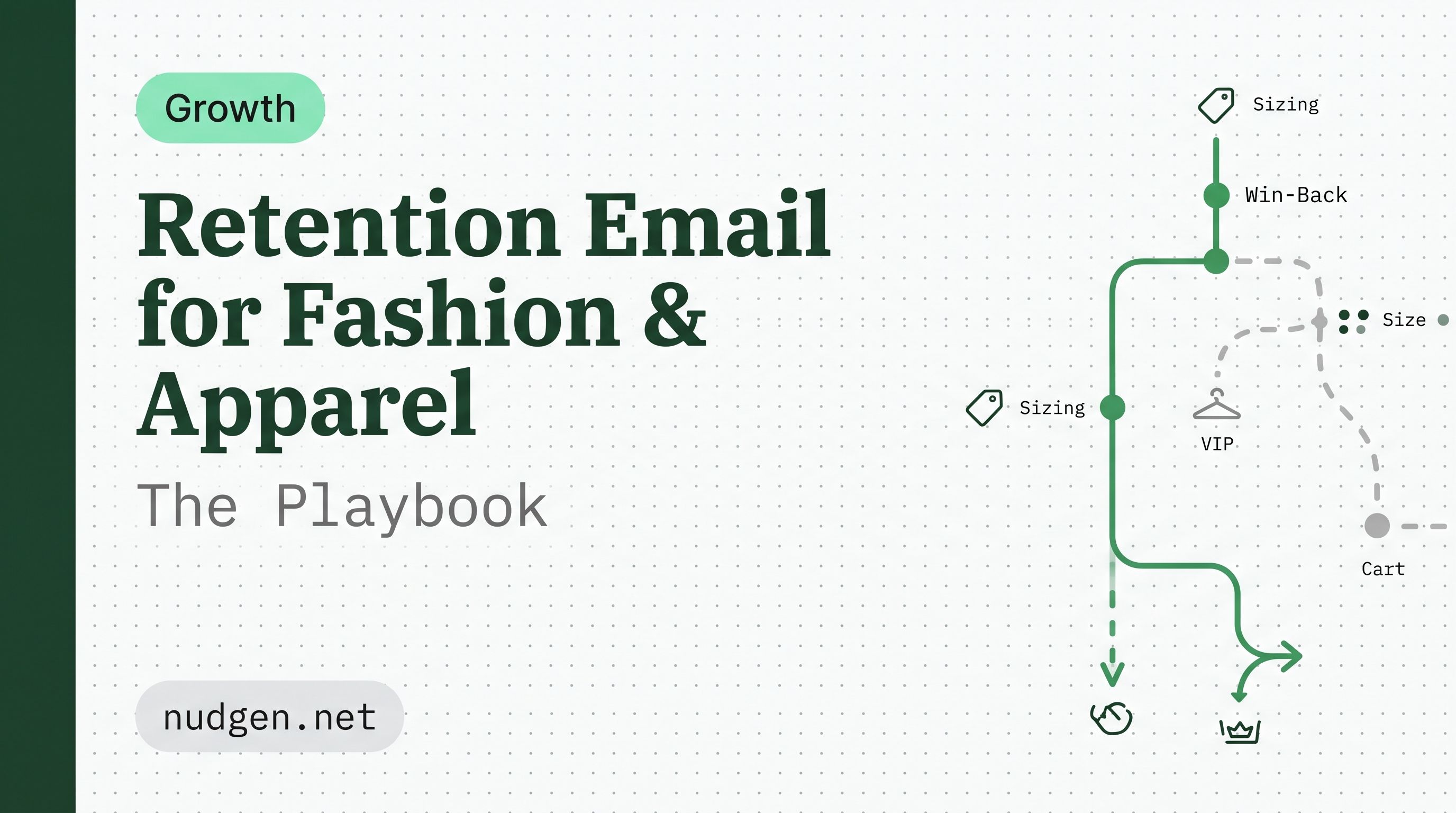
Retention Email for Fashion & Apparel Brands: The Playbook
By Tuyet Tran · Jul 20, 2026
Your spring collection sold out in two weeks. Great.
But half the orders came back as returns. Another 40% of customers haven't opened an email since Black Friday. And the shoppers who bought from three different drops last year? They haven't purchased in six months.
Fashion retention is different from every other vertical. The buying cycles are seasonal. Returns are baked into the model. And a customer who buys a t-shirt once is not the same as someone who buys every new drop.
This playbook covers the four retention workflows that matter most for apparel brands — written for operators who need something they can set up this week, not a six-month CRM project.
Why Fashion Retention Breaks the Standard Playbook
Most retention advice assumes customers buy on a predictable cycle. They don't.
In apparel, someone might buy three times in one month (a new drop, a sale item, a gift), then disappear for nine months. Standard win-back sequences — "We miss you, here's 10% off" — don't account for the fact that they'll come back when the next season's collection drops, not when your email hits their inbox.
Three dynamics make fashion retention unique:
- Returns are part of the funnel. Apparel return rates can run 20–30%, and a return is not the same as churn. A customer who returned one size might buy again immediately — if you handle the moment right.
- Seasons dictate behavior. Your customer's likelihood of buying next month depends more on your product calendar than on how many emails you send.
- Not all repeat buyers are equal. Someone who buys from every collection drop is a different breed from someone who buys twice during a clearance event. They need different treatment.
Workflow 1: Post-Purchase Sizing Follow-Ups
A customer buys a pair of jeans. They arrive. They don't fit. They return them.
If your next touchpoint is a generic "New arrivals!" email three weeks later, you've lost the thread. That customer was interested enough to buy. The issue was fit, not intent.
What to do instead:
- Trigger a sizing check-in 3–5 days after delivery. Ask: "How's the fit?" with a simple one-click response — "Perfect," "Too small," "Too big."
- If they say "Too small," send them to the size-up listing immediately. If they say "Too big," send them to size-down.
- If they return the item without responding, send a follow-up after the refund processes: "Looks like the [product name] didn't work out. Here are similar styles — want to try a different size?"
Why this works: You're addressing the actual reason they returned (fit) instead of pretending it didn't happen. You're also collecting fit preference data that can inform future recommendations.
Example flow:
- Day 3 post-delivery: "How's the fit on your [product]?" with size feedback buttons
- If no response + return initiated: "We saw the return come through. Want to try [product] in [alternate size]?"
- If they ordered a new size: Welcome them back into the regular post-purchase flow
This turns a return into a retention opportunity instead of a dead end.
Workflow 2: Cart Abandonment That Reads the Intent
Fashion shoppers abandon carts for different reasons than, say, electronics buyers. Price hesitation is one factor. But size indecision — opening three tabs with S, M, and L, adding one to cart, then bailing — is a uniquely apparel problem.
Two distinct abandonment angles:
For size indecision: If a shopper visited multiple size pages or viewed the size chart before abandoning, the email shouldn't lead with a discount. It should lead with fit reassurance.
Good subject line: "Not sure about the size? Here's how the [product] fits."
Body: Show the size chart again. Include a line about the return policy ("Free exchanges if it doesn't fit"). Remove the friction, not the price.
For price hesitation: If the shopper browsed the sale section or visited the product page multiple times before abandoning, a small incentive might make sense. But frame it around timing, not desperation.
Good subject line: "The [product] is still in your cart — and stock is moving."
Body: Mention that inventory is limited for that size or color. Create urgency around availability, not a discount race.
Don't do this: "You forgot something! 15% off if you buy now." That trains customers to abandon every cart waiting for a discount code.
Workflow 3: Seasonal Win-Back Timing
A customer who bought a winter coat in November and hasn't purchased since April is not a "lapsed" customer. They're just not buying coats in summer.
Standard win-back sequences fire after X days of inactivity. For apparel, that timer needs to sync with your product calendar, not an arbitrary date.
How to structure seasonal win-back:
- Segment by last purchase category. A coat buyer should re-enter your active audience when the next cold-weather collection drops, not in June.
- Use two-tier timing. Send a light re-engagement email after 90 days of inactivity — just a check-in: "Still into [brand]?" If they open it, they're still warm. Reset the clock. If they don't, keep them in a seasonal hold pattern until the next relevant collection.
- End-of-season clearance is a different play. These customers aren't inactive; they're waiting for deals. A "Last chance before the season turns" email 2–3 weeks before a collection flips can bring them back at full margin before they wait for clearance.
Example seasonal calendar for a general apparel brand:
The key: don't treat every inactive customer the same way. Match the re-engagement to what they bought last.
Workflow 4: VIP Treatment for Multi-Drop Buyers
A customer who buys from three or more collection drops in a year is not a regular customer. They're a brand fan. And they should not be getting the same "Welcome back" emails as a one-time clearance shopper.
What a VIP path looks like:
- Early access notifications. Let them shop new drops 24–48 hours before the general list. This costs you nothing and builds serious loyalty.
- Skip the discount ladder. If someone buys at full price three times a year, don't train them to wait for a coupon. Send exclusive content — a lookbook, a behind-the-scenes email, a founder note — instead of a discount.
- Separate the win-back logic. If a VIP goes quiet for two drops, don't send them the standard "We miss you" email. Send something personal: "We noticed you haven't picked up the last couple collections. Everything okay? Here's what's new — no pressure."
How to identify VIPs (simple version, no data team needed):
- 3+ purchases in the last 12 months
- Average order value above a threshold (e.g., top 25% of your store)
- Purchased across at least two different collections or seasons
Put them in a separate segment. Treat them differently. The ROI on keeping a VIP is far higher than acquiring a new customer.
Enter Nudgen
You don't need a marketing team to run these workflows. Nudgen is built for operators who want retention email that works without spending weeks on setup.
- AI-assisted drafting — describe the campaign (e.g., "post-purchase sizing follow-up for jeans") and Nudgen generates a first draft you can edit, not a template you're stuck with.
- Campaign controls — set exactly who enters each flow: tag by purchase category, order count, or last activity date. No guesswork about who's receiving what.
- Stop rules — the moment a customer clicks through, makes a purchase, or unsubscribes, Nudgen pauses further emails in that sequence. No over-messaging. No awkward "Here's 10% off" two days after they already bought.
Each workflow in this playbook is something you can build and launch the same day — with copy that sounds like your brand, not a generic email template.
Ready to Build Your First Fashion Retention Flow?
The brands that win in apparel aren't the ones with the biggest ad budgets. They're the ones that turn a first purchase into a second, a return into an exchange, and a seasonal buyer into a year-round fan.
Pick one workflow from this playbook and set it up today. Set up your first campaign in minutes — no credit card required.
Recently Published
View all posts
Top 5 AI Email Generator Tools for 2026
Discover the top 5 AI email generator tools for 2026 — how they compare on automation features, integrations, pricing, and free tiers, and which one fits your workflow best.
Top 5 AI Email Assistant Tools for 2026
Inbox overload hurts productivity. Discover the 5 best AI email assistant tools for 2026 that can calm the chaos and boost your output.

The Complete Guide to Cold Email Outreach in 2026
Learn how to build high-performing cold email campaigns in 2026, from infrastructure and compliance to personalization, sequencing, and multi-channel outreach.
References
Ready to supercharge your outreach & retention?
Join 1,000+ top performers using Nudgen to automate lead generation, close more deals, and keep customers longer.
Get Started Free