

17 min read
Enterprise Cold Email: How to Reach Decision-Makers at Large Companies
By Toan Nhu · May 19, 2026
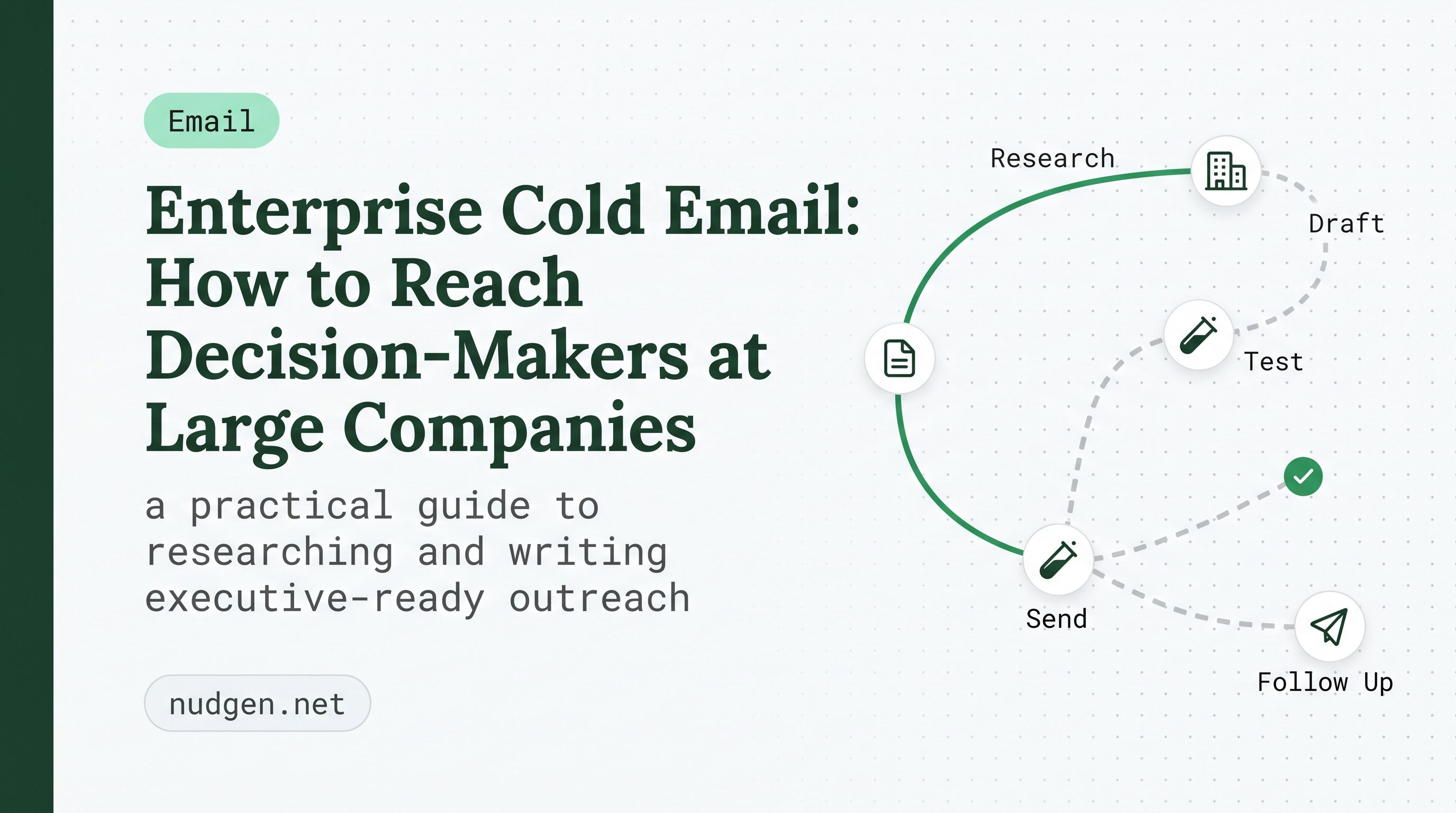
Enterprise Cold Email: How to Reach Decision-Makers at Large Companies
Enterprise cold email is not the same game as SMB outreach.
A short, clever message might work when you are selling to a small team with one decision-maker. It usually falls flat when you are trying to start a conversation with a large company. Enterprise buyers have longer timelines, more stakeholders, stricter risk controls, and far more vendors competing for their attention.
That does not mean cold email is dead for enterprise sales. It means the bar is higher.
To win enterprise conversations, your email has to feel relevant, credible, and useful from the first line. You need to understand the account, map the buying committee, personalize by role, and follow up without sounding desperate. The goal is not to pressure someone into a quick call. The goal is to earn enough trust to begin a serious business conversation.
This guide explains how to build enterprise cold email campaigns that reach decision-makers, create account-level momentum, and support long sales cycles. It also shows how Nudgen can help lean teams write better emails, manage drip sequences, personalize outreach, and stop follow-ups when prospects or customers engage.
Understanding Enterprise Buyers
What Makes Enterprise Outreach Different
Enterprise buyers operate in a different environment from small-business buyers.
They are not just evaluating whether your product looks useful. They are asking questions like:
- Will this create measurable business impact?
- Will it integrate with the systems we already use?
- Will it introduce operational, legal, security, or compliance risk?
- Will the vendor still be reliable after procurement is complete?
- Will implementation require too much internal effort?
- Can this help our team hit a priority that already matters this quarter?
Enterprise cold email needs to respect that reality.
The first email should not read like a generic pitch. It should show that you understand the company, the buyer's role, and the business context around the problem you solve.
Key differences include:
- Longer buying cycles: Enterprise deals can take months because decisions move through research, internal alignment, procurement, legal, security, and implementation planning.
- More stakeholders: You are rarely selling to one person. You may need buy-in from business, technical, finance, legal, and user-level teams.
- Higher risk sensitivity: Large companies care deeply about security, privacy, stability, implementation risk, and vendor credibility.
- More vendor noise: Executives and senior operators receive constant sales outreach. Weak personalization gets ignored quickly.
- Relationship-driven decisions: A cold email is often only the first touch. The real win is creating trust across multiple interactions.
Enterprise Reply Rates and Pipeline Value
Enterprise reply rates are often lower than SMB reply rates, but the value of each positive reply is much higher.
A healthy enterprise cold email campaign should not be judged by reply volume alone. It should be judged by account quality, positive reply rate, meetings created, opportunity progression, and long-term pipeline influence.
A practical benchmark framework:
| Target deal size | Expected reply rate | Sales cycle | What matters most |
|---|---|---|---|
$50K–$100K ACV | 8–12% | 3–6 months | Relevance and clear business pain |
$100K–$250K ACV | 6–10% | 6–12 months | Internal priority and stakeholder fit |
$250K+ ACV | 5–8% | 12+ months | Strategic timing, credibility, and multi-threading |
Lower reply rates do not automatically mean poor performance. If each qualified meeting can create meaningful pipeline, a small number of high-quality conversations can outperform a high-volume campaign aimed at weak-fit accounts.
What Enterprise Buyers Care About
Enterprise buyers care less about how exciting your product sounds and more about whether it is safe, relevant, and worth prioritizing.
They usually care about:
- Security and compliance
- Integration with existing systems
- Vendor reliability
- Total cost of ownership
- Implementation timeline
- Internal adoption risk
- Similar customer references
- Clear business outcomes
They usually care less about:
- Generic feature lists
- Startup hype
- "We can save you 10x time" claims without proof
- Broad "partnership opportunity" language
- Personalization that only uses their first name and company name
The best enterprise cold emails connect your solution to something the buyer already cares about.
Account Research for Enterprise Cold Email
Start With Company-Level Research
Enterprise outreach should begin at the account level, not the contact level.
Before writing to anyone, understand why this company is worth reaching now. Good enterprise campaigns are built around timing. You are looking for evidence that the account has a current priority connected to the problem you solve.
Useful company-level signals include:
- New leadership hires
- Public strategic initiatives
- Digital transformation projects
- Geographic expansion
- Recent acquisitions or mergers
- New product launches
- Cost-control initiatives
- Hiring patterns that reveal operational priorities
- Compliance or regulatory pressure
- Competitive threats in the market
For Nudgen, good-fit signals might include:
- A company is investing in customer retention.
- A SaaS team is trying to improve onboarding or activation.
- An e-commerce brand is focused on repeat purchase rate.
- A marketplace is trying to bring back inactive users.
- A business is hiring lifecycle, growth, CRM, or retention marketers.
- A founder-led team wants automation without heavy enterprise software.
Research the Buyer Committee
Do not stop after finding one executive.
Enterprise buying committees usually include multiple roles. Each role cares about the same initiative from a different angle.
| Role | Function | Messaging focus |
|---|---|---|
Economic buyer | Owns budget and business case | ROI, customer lifetime value, revenue impact |
Technical buyer | Evaluates fit and implementation | Data flow, integrations, security, reliability |
User buyer | Uses or manages the tool day to day | Ease of setup, workflow speed, campaign control |
Champion | Advocates internally | Clear value story, internal visibility, quick wins |
Blocker | Can slow or stop the deal | Risk reduction, compliance, operational clarity |
If you sell Nudgen into a larger company, the CMO might care about lifecycle revenue, the Head of Growth might care about faster experimentation, the CRM manager might care about segmentation and reporting, and the operations team might care about reducing manual campaign work.
Each stakeholder needs a different reason to care.
Trigger Events for Enterprise Outreach
A trigger event gives your outreach timing.
High-value triggers include:
- A new executive joins the company.
- The company announces a retention, growth, or customer experience initiative.
- The company expands into a new market.
- A leadership team mentions customer lifetime value, churn, or repeat purchase rate.
- The company is consolidating tools after a merger or acquisition.
- The team is hiring for lifecycle marketing, CRM, or growth roles.
Medium-value triggers include:
- Conference talks or podcast appearances
- Published thought leadership
- New product launches
- Public customer experience updates
- New funding or budget expansion
- Industry regulation changes
For Nudgen, the strongest trigger is usually behavior that suggests a company needs smarter follow-up: abandoned carts, inactive users, churn risk, weak onboarding completion, or retention campaigns stuck in manual workflows.
Crafting Enterprise Cold Emails
The Enterprise Email Formula
A strong enterprise cold email usually includes five elements:
- Credibility first — Explain why you are worth reading.
- Strategic relevance — Connect your message to a known company priority.
- Role-specific insight — Show that you understand the buyer's world.
- Risk reduction — Address the likely concern before they raise it.
- Low-friction CTA — Ask for a small next step, not a big commitment.
The email should feel like a useful business note, not a mass campaign.
Subject Lines for Executives
Good enterprise subject lines are specific and calm.
Examples that work:
- Question about [Company]'s retention motion
- [Strategic initiative] + lifecycle follow-up
- For [Name]: reducing manual CRM work
- [Mutual connection] suggested I reach out
- Idea for [Company]'s post-purchase flow
Examples that usually fail:
- Partnership opportunity with Nudgen
- 15 minutes?
- Quick question
- Boost revenue 10x with AI
- Congrats on the funding!
The subject line should sound like a peer-to-peer business conversation, not an attention trick.
Opening Lines That Work
The opening line should prove the email was written for this person and this account.
Use one of these angles:
Strategic initiative reference
I saw [Company] is investing in [initiative]. That usually creates a follow-up challenge after users show intent but do not complete the next action.
Recent news reference
Noticed the announcement about [Company]'s expansion into [market]. For teams entering a new market, onboarding and repeat engagement often become harder to manage manually.
Role-specific problem reference
Since you lead growth at [Company], I imagine one of the harder parts is turning product behavior into timely lifecycle messages without overloading the team.
Peer insight reference
We are seeing more teams move away from one-off email blasts and toward behavior-based retention flows that stop once the user engages.
Body Copy Patterns for Enterprise
Pattern 1: Strategic Alignment
Hi [Name],
I saw [Company] is focused on [strategic initiative]. When teams scale that motion, one common challenge is turning customer behavior into timely follow-up without adding more manual CRM work.
Nudgen helps growing teams launch retention and lifecycle email campaigns with AI-generated drafts, audience targeting, and stop rules that pause follow-ups once someone clicks, purchases, or unsubscribes.
Would it be useful if I shared a simple flow your team could test for [specific use case]?
Pattern 2: Risk Reduction
Hi [Name],
A lot of growth teams want more automation, but they are careful about over-messaging users or sending campaigns that feel disconnected from the customer journey.
That is exactly why Nudgen is built around practical controls: editable AI drafts, audience previews, pre-send testing, contact-level status, and auto-stop rules.
Open to a short conversation on how this could fit into [Company]'s lifecycle workflow?
Pattern 3: Peer Positioning
Hi [Name],
We are seeing more teams treat retention as an execution problem, not just a strategy problem. The gap is usually not knowing what to say. It is getting the right message live fast, to the right segment, with the right stopping logic.
Nudgen helps teams move from manual follow-ups to behavior-based campaigns for onboarding, win-back, post-purchase, and abandoned-cart moments.
Worth comparing notes on how [Company] is handling this today?
Full Enterprise Cold Email Templates for Nudgen
Template 1: Strategic Initiative
Subject: [Company]'s [initiative] + lifecycle question
Hi [Name],
[Company]'s work around [initiative] caught my attention, especially [specific detail]. When teams scale that kind of motion, customer follow-up often becomes harder to manage manually.
Nudgen helps teams launch retention email campaigns faster with AI-generated copy, tag-based audience segments, and stop rules that pause the sequence after a click, purchase, or unsubscribe.
Would it be useful to share a simple campaign structure for [specific customer moment]?
Best,
[Your Name]
Template 2: New Growth or Marketing Leader
Subject: Welcome to [Company], [Name]
Hi [Name],
Congrats on the new role at [Company]. The first few months in a growth or lifecycle role usually involve finding quick wins without creating extra operational complexity for the team.
One area we often see is retention follow-up: users sign up, browse, buy once, or go inactive, but the next message either happens too late or not at all.
Nudgen helps teams launch those campaigns quickly with editable AI drafts, audience previews, drip sequences, and auto-stop rules.
Worth a brief conversation as you map the first priorities?
Best,
[Your Name]
Template 3: Retention Problem
Subject: Reducing manual retention follow-up at [Company]
Hi [Name],
Many teams have the same issue: they know which users need a nudge, but turning that insight into a live campaign takes too much setup.
Nudgen is built for that gap. Teams can choose an audience, review an AI-generated draft, launch a one-time or drip campaign, and stop future emails automatically when the customer engages.
Would you be open to seeing how a win-back or post-purchase flow could work for [Company]?
Best,
[Your Name]
Template 4: E-commerce Retention
Subject: Idea for [Company]'s repeat purchase flow
Hi [Name],
I noticed [Company] has a strong first-purchase experience. The next opportunity may be turning more of those first-time buyers into repeat customers.
Nudgen helps teams create post-purchase and win-back email campaigns with personalized AI drafts, audience tags, and stop rules so customers do not keep receiving reminders after they act.
Would it be useful if I shared a lightweight repeat-purchase flow your team could test?
Best,
[Your Name]
Template 5: SaaS Activation
Subject: Activation follow-up at [Company]
Hi [Name],
For SaaS teams, activation usually depends on a few key actions: completing setup, inviting a teammate, using a core feature, or returning after the first session.
The hard part is sending the right follow-up based on those moments without building a complex lifecycle system from scratch.
Nudgen helps teams launch behavior-informed email campaigns with editable AI copy, segmented audiences, drip steps, and clear reporting.
Open to discussing one activation flow that could be useful for [Company]?
Best,
[Your Name]
Multi-Stakeholder Enterprise Sequences
Use an Account-Based Approach
Enterprise outreach works better when it is organized around accounts, not isolated leads.
Instead of sending the same message to one person repeatedly, map the account and create a coordinated sequence across multiple stakeholders.
Example structure:
Week 1
- Email the primary target with a strategic business angle.
- Connect with a secondary stakeholder on LinkedIn.
- Save relevant company news and role-specific notes.
Week 2
- Follow up with a different proof point or workflow idea.
- Email a technical or operational stakeholder with implementation context.
- Engage lightly with public content from the account.
Week 3
- Send a practical example, such as a sample lifecycle flow.
- Reach a user-level buyer with workflow-specific messaging.
- Follow up with the primary target using a concise value-add.
Week 4+
- Continue with lower-frequency touches.
- Share relevant content, benchmarks, or examples.
- Move strong-fit accounts into longer-term nurture.
Coordinate Messaging by Role
When multiple people at the same account receive outreach, the messages should support each other.
A Head of Growth might receive:
I wanted to share an idea for improving activation and win-back campaigns without adding another complex marketing suite.
A CRM or lifecycle manager might receive:
I thought this may be relevant because Nudgen helps teams build drip campaigns with audience previews, editable drafts, pre-send testing, and contact-level status tracking.
A technical stakeholder might receive:
The main reason I am reaching out is to understand whether customer behavior data can support more timely lifecycle emails while keeping campaign controls simple.
Each email should be personalized, but the account story should stay consistent.
Enterprise Sequence Timing
Enterprise outreach should be slower than SMB outreach.
A practical timing model:
| Touch | Timing | Focus |
|---|---|---|
Email 1 | Day 0 | Strategic relevance |
Email 2 | Day 5 | Different angle or proof |
Email 3 | Day 12 | Useful example or workflow idea |
Day 15 | Light relationship touch | |
Email 4 | Day 20 | Direct question |
Email 5 | Day 30 | Soft close |
Long-term nurture | Monthly | Insight, content, or trigger-based follow-up |
Do not chase enterprise buyers with daily follow-ups. Space out your touches and make each one useful.
Multi-Channel Support
Enterprise outreach usually works best across more than one channel.
Useful channels include:
- Email: Primary outreach and structured follow-up
- LinkedIn: Relationship building and content engagement
- Phone: High-value meeting scheduling when appropriate
- Events: Conferences, webinars, founder meetups, and industry sessions
- Content: Reports, guides, benchmarks, and teardown-style insights
- Introductions: Warm paths through investors, customers, partners, or community members
Email should remain the center of the sequence, but other channels create familiarity and trust.
Credibility Elements
How to Position Nudgen in Enterprise Outreach
Enterprise buyers need to know why they should trust the conversation.
For Nudgen, credibility should focus on practical execution:
- AI-generated email drafts that remain editable before sending
- Audience previews so teams know exactly who will be reached
- One-time and drip campaigns for common lifecycle moments
- Stop rules for clicks, purchases, and unsubscribes
- Brand voice consistency
- Contact-level campaign tracking
- Clear reporting on sends, delivery, opens, clicks, unsubscribes, and bounces
- Retention-focused use cases such as welcome flows, abandoned-cart recovery, post-purchase nurture, and win-back campaigns
Avoid making broad enterprise claims unless you can support them. For example, do not claim deep Salesforce integration, SOC 2 certification, or Fortune 500 case studies unless those are already true and published.
A stronger positioning line:
Nudgen helps growing teams launch retention and lifecycle email campaigns quickly, with AI drafts, practical campaign controls, and stop rules that keep follow-up helpful instead of noisy.
Enterprise Email Signature
Your signature should make it easy for a buyer to understand who you are and why the email is legitimate.
Include:
- Full name
- Title
- Company name
- Website
- LinkedIn profile
- Optional calendar link
- Optional compliance or trust note if applicable
Example:
Toan Nhu
Founder | Nudgen
Retention email automation for growing businesses
https://nudgen.net
LinkedIn: https://linkedin.com/in/toannhu
Use Thought Leadership Instead of Hard Selling
Enterprise buyers respond better to useful perspective than pressure.
Content you can share:
- A teardown of a common retention flow
- A benchmark-style post about onboarding or win-back campaigns
- A short guide to stop rules in lifecycle email
- A checklist for abandoned-cart recovery
- A case study once you have customer proof
- A short Loom showing how a sample campaign could work
Example line:
We just put together a simple breakdown of how teams can stop over-messaging users after they click or buy. Thought it might be relevant given your focus on lifecycle engagement.
This positions Nudgen as helpful and practical, not just another email tool.
Common Enterprise Cold Email Mistakes
Mistake 1: Treating Enterprise Like SMB
Wrong:
Quick pitch, fast CTA, generic value proposition.
Right:
Account-specific research, business context, role-specific messaging, and a low-friction next step.
Mistake 2: Single-Threading
Wrong:
Emailing one executive five times and hoping they forward it internally.
Right:
Mapping the buying committee and sending coordinated messages to 3–5 relevant stakeholders.
Mistake 3: Leading With Features
Wrong:
Nudgen has AI drafts, drip sequences, analytics, and audience tags.
Right:
Nudgen helps teams turn customer behavior into timely retention emails without building a complex lifecycle marketing system.
Mistake 4: Ignoring Risk
Wrong:
Assuming the buyer only cares about growth.
Right:
Explaining how the campaign stays controlled through previews, test sends, audience selection, unsubscribe handling, and stop rules.
Mistake 5: Using Generic Social Proof
Wrong:
Trusted by modern teams worldwide.
Right:
Built for growing businesses that need practical retention campaigns without enterprise setup drag.
When you have specific proof, use it. Until then, keep positioning honest and focused.
Mistake 6: Pushy Follow-Ups
Wrong:
Sending repeated "bumping this" emails every day.
Right:
Sending spaced-out follow-ups that add a new angle, example, or useful idea.
Mistake 7: No Stop Logic
Wrong:
Continuing to send the same sequence after someone clicks, replies, purchases, or unsubscribes.
Right:
Use stop rules so the sequence adapts once the recipient engages.
This is especially important for Nudgen's positioning. The goal is not more email for the sake of more email. The goal is smarter follow-up that stops when it has done its job.
Measuring Enterprise Cold Email
Key Metrics
Measure enterprise cold email at both the contact level and the account level.
| Metric | What it tells you |
|---|---|
Open rate | Whether deliverability and subject lines are working |
Reply rate | Whether the message is relevant enough to start conversations |
Positive reply rate | Whether targeting and offer quality are strong |
Meeting rate | Whether conversations are converting into pipeline |
Account engagement | Whether multiple stakeholders are interacting |
Sequence completion | Whether follow-up volume and timing are reasonable |
Unsubscribe rate | Whether messaging is too broad or too frequent |
Stop-rule activation | Whether recipients are engaging before later steps send |
For Nudgen campaigns, pay close attention to stop-rule activation. If contacts are clicking, buying, or unsubscribing before the full sequence completes, your automation should adjust automatically.
Long-Term Tracking
Enterprise outcomes take time.
Track performance in windows:
First 30 days: opens, clicks, replies, unsubscribes, and stop-rule activation
90 days: meetings booked and qualified opportunities created
180 days: opportunity progression and stakeholder engagement
365 days: closed-won attribution and account expansion
Do not judge enterprise outreach only by what happens in the first week.
How Nudgen Helps With Enterprise-Style Email Campaigns
Nudgen is built for teams that want useful email campaigns live quickly without the complexity of traditional enterprise suites.
For enterprise-style outreach and lifecycle campaigns, Nudgen can help with:
AI-Generated Drafts
Start from a campaign goal and let Nudgen generate a first draft. You can edit the message, adjust tone, and keep the copy aligned with your brand before sending.
Audience Targeting
Use tags, imported contacts, or selected recipient groups to define who should enter a campaign. Audience previews make the setup explicit before launch.
Drip Sequences
Run one-time campaigns or multi-step drip sequences for outreach, onboarding, win-back, abandoned cart, post-purchase, and retention use cases.
Stop Rules
Stop future emails after a click, purchase, or unsubscribe. This keeps campaigns helpful and prevents redundant follow-up.
Pre-Send Testing
Preview and test emails before launch so your team can review copy, links, formatting, and audience selection.
Campaign Analytics
Track sent, delivered, opened, clicked, unsubscribed, and bounced outcomes from one view. This gives teams practical visibility without requiring analyst-level tooling.
Simple Operating Model
Nudgen is especially useful for lean teams that need speed, control, and clear campaign execution without spending weeks building complex workflow diagrams.
Key Takeaways
- Enterprise cold email requires more research, patience, and credibility than SMB outreach.
- The best enterprise emails connect to a real company priority or trigger event.
- Multi-threading matters. Reach the buying committee, not only one person.
- Role-specific messaging beats generic personalization.
- Enterprise sequences should be spaced out and value-led.
- Nudgen fits teams that want AI-assisted campaign creation, simple audience targeting, drip sequences, and stop rules.
- Strong outreach does not mean sending more emails. It means sending better emails and stopping when the recipient engages.
Frequently Asked Questions
What reply rate should I expect from enterprise cold email?
A well-targeted enterprise campaign may produce lower reply rates than SMB outreach, but each positive reply can represent much larger pipeline potential. Focus on positive replies, meetings, account engagement, and opportunity quality instead of reply volume alone.
How long should an enterprise sequence be?
A good initial sequence often includes 5–7 touches over 4–6 weeks. After that, strong-fit accounts can move into long-term nurture with lower-frequency, value-added touchpoints.
Should I email multiple people at the same company?
Yes. Enterprise decisions usually involve multiple stakeholders. Map economic buyers, technical buyers, user buyers, champions, and possible blockers. Keep the messaging coordinated but role-specific.
How does Nudgen support enterprise-style campaigns?
Nudgen helps teams create AI-assisted email campaigns, target specific audiences, run drip sequences, preview and test before launch, track campaign outcomes, and stop follow-ups when contacts click, purchase, or unsubscribe.
What is the biggest mistake in enterprise cold email?
The biggest mistake is treating enterprise buyers like small-business buyers. Enterprise outreach needs account research, business relevance, stakeholder mapping, and credibility. Generic pitches rarely earn attention.
How can I avoid annoying prospects with follow-ups?
Space out your sequence, make every message useful, and use clear stop logic. If someone clicks, replies, purchases, or unsubscribes, the campaign should not continue as if nothing happened.
What should I test first?
Start with one narrow account segment and one clear use case. Test the subject line, opening angle, CTA, and timing. For Nudgen, also monitor stop-rule activation because it shows where recipients are engaging before the full sequence finishes.
Conclusion
Enterprise cold email works when it respects how enterprise buying actually happens.
Large-company buyers do not need another generic pitch. They need relevant insight, clear timing, credible context, and a reason to believe the conversation is worth their attention. That means researching the account, mapping stakeholders, writing by role, and following up with discipline.
Nudgen helps teams bring that discipline into email execution. With AI-generated drafts, audience targeting, drip sequences, pre-send testing, campaign analytics, and stop rules, teams can launch smarter outreach and retention campaigns without unnecessary complexity.
Start with one account segment. Choose one customer or buyer moment. Write a message that connects to a real priority. Then use Nudgen to launch, measure, and improve the campaign while keeping follow-up helpful, controlled, and easy to manage.
Recently Published
View all posts
Top 5 AI Email Generator Tools for 2026
Discover the top 5 AI email generator tools for 2026 — how they compare on automation features, integrations, pricing, and free tiers, and which one fits your workflow best.
Top 5 AI Email Assistant Tools for 2026
Inbox overload hurts productivity. Discover the 5 best AI email assistant tools for 2026 that can calm the chaos and boost your output.
The Complete Guide to Cold Email Outreach in 2026
Learn how to build high-performing cold email campaigns in 2026, from infrastructure and compliance to personalization, sequencing, and multi-channel outreach.
References
Ready to supercharge your outreach & retention?
Join 1,000+ top performers using Nudgen to automate lead generation, close more deals, and keep customers longer.
Get Started Free