
قراءة 6 دقائق
Lifecycle Email for People Who Hate Marketing: A One-Hour Setup
بقلم Tuyet Tran · 6 يوليو 2026
You shipped the product. You set up the store. Orders are trickling in.
And now everyone says you need "email marketing." Newsletters. Segmentation. A/B testing. Funnels.
You don't have a marketing person. You don't have a marketing hour. The last thing you want is another dashboard to check.
Here's the good news: you don't need any of that. You need three emails. Set them up once, and they run forever.
These are the emails that pay rent — the ones that fire automatically when a customer does something (or doesn't do something). They cost nothing to run, they don't need babysitting, and they reliably outperform any batch-and-blast newsletter you'd send to your entire list.
The Three Emails That Actually Move Money
Most small Shopify stores send zero automated emails. Some send one — usually a welcome discount. Almost nobody sends all three.
That means just having these in place puts you ahead of 80% of stores your size.
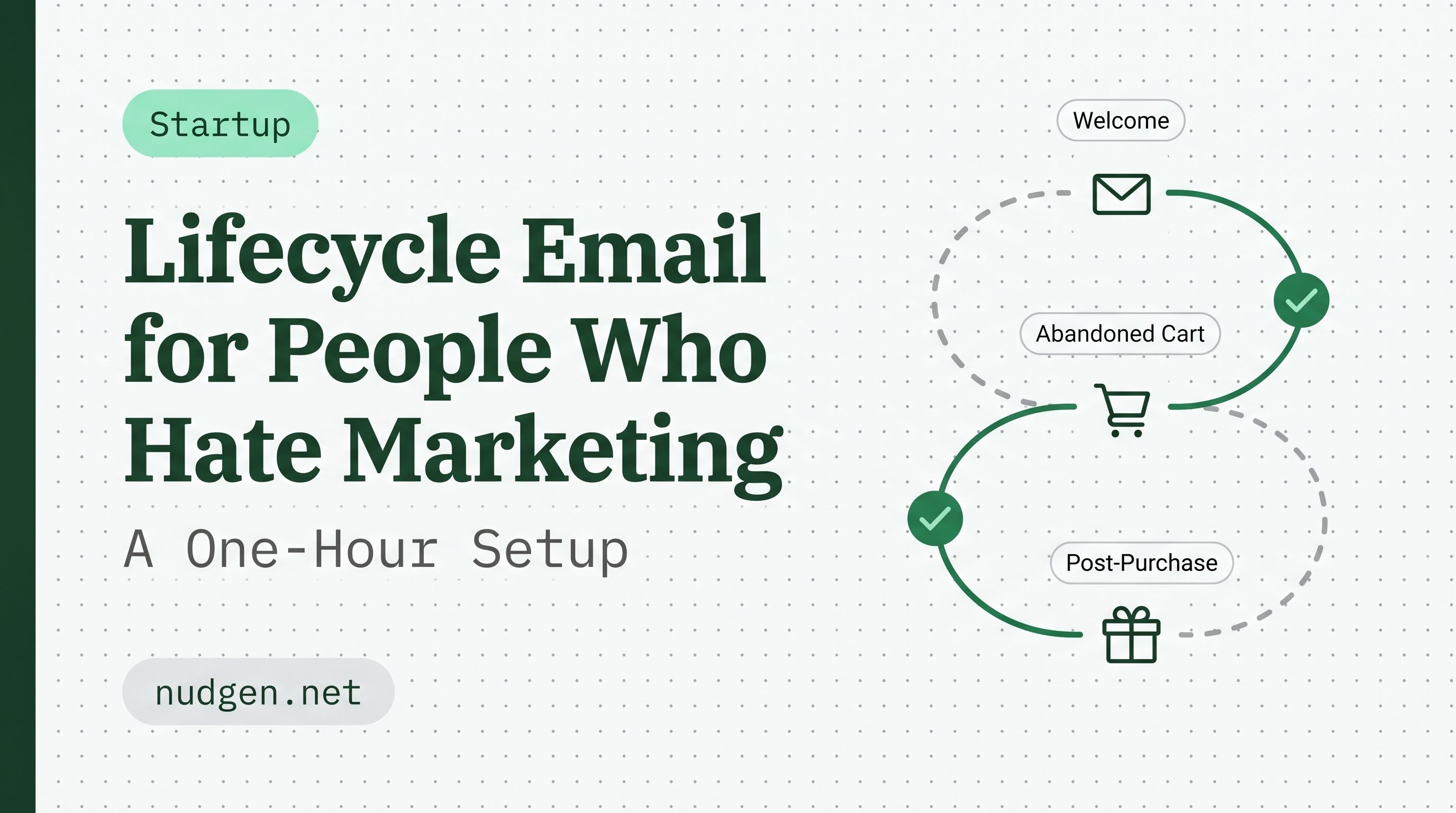
1. The Welcome Email (fires on signup)
Someone gave you their email. That's a small act of trust. The welcome email is your chance to reward it — and set expectations before they forget who you are.
What it does: Introduces your brand voice, delivers any promised incentive (discount code, free shipping), and points to your best content or product category.
When to send it: Immediately after signup. Not 10 minutes later. Not in a "daily digest." Right now.
What to write (3 paragraphs max):
- Line 1: Thank them. Be specific about what you do.
- Line 2: Here's the discount code you promised (if you offered one).
- Line 3: One link to your most helpful resource — a buying guide, a bestseller page, or a "how to get started" article.
Example: "Thanks for joining [Store Name]. We make [specific product category] for [specific person]. Here's 10% off your first order: WELCOME10. If you're not sure where to start, our bestsellers page is here."
That's it. No manifesto. No founder story. No "here are 17 things you can do with our app." Three lines, one link, done.
2. The Abandoned Cart Email (fires when someone leaves without buying)
The average cart abandonment rate across ecommerce is around 70%. That means for every 10 people who add something to cart, 7 leave without paying.
A single cart recovery email brings back 3-5% of those people. Three emails in a sequence bring back 8-12%. Those are real orders you already earned — you just need to ask.
What it does: Reminds them what they left, removes friction, and gives a reason to act now.
When to send it: First email at 1 hour after abandonment. Second at 24 hours. Third at 72 hours (optional — start with one).
What to write:
- Subject: "Still thinking about it?" or "Your cart is waiting"
- Body: Show what they left (product name, image, price). One line of social proof ("Rated 4.8 by 200+ customers"). One clear button back to checkout.
- No discount in the first email. Save incentives for the second or third touch — many customers will complete the purchase without one.
3. The Post-Purchase Follow-Up (fires X days after delivery)
Most stores go silent after the sale. That's a mistake — this is when the customer has the most trust in you. They just paid you money and received your product.
A well-timed follow-up does two things: it catches problems before they become public reviews, and it opens the door to a second purchase.
What it does: Checks in on the product experience, asks for feedback, and suggests a logical next purchase.
When to send it: Based on your product. For consumables (coffee, supplements), send when they're about to run out. For durable goods (clothing, gear), send 7-10 days after delivery.
What to write:
- Ask if everything arrived okay. One-sentence check-in.
- Request a review or feedback (link to your review page, not a 20-question survey).
- Suggest one complementary product — not your entire catalog.
Example: "Hey [Name], hope the [product] is working out. If anything's off, just reply to this email — I read every one. Love it? We'd appreciate a quick review here. By the way, a lot of people pair it with [complementary product] — here's the link."
How to Build This in About an Hour
You don't need a marketing degree for this. You need a tool that handles the automation part, and 60 minutes of focused time.
Minutes 0-15: Write the emails
Open a blank doc. Write three emails following the templates above. Don't overthink it. Don't wordsmith subject lines. The first version just needs to be clear and human.
Write like you'd write to one actual customer. Not a "segment." Not a "persona." One person who bought your thing.
Minutes 15-30: Set up the triggers
In your email platform (Nudgen, Klaviyo, Mailchimp — whatever you use), create three automations:
- Welcome flow: Trigger = subscriber added to list. Action = send email immediately.
- Cart recovery flow: Trigger = checkout started but not completed. Action = send email after 1 hour. (Add a stop rule: cancel if they complete the purchase.)
- Post-purchase flow: Trigger = order fulfilled/delivered. Action = send email after X days.
Minutes 30-50: Configure stop rules
This is the part most people skip — and it's the difference between helpful and annoying.
For every automated email, add a condition that stops the sequence if the customer already took the desired action:
- Welcome: Stop if they already placed an order before the email sends.
- Cart recovery: Stop if they completed checkout. Stop all further cart emails.
- Post-purchase: Stop if they already left a review or made a second purchase.
Without stop rules, you get the "I already bought this, why are you still emailing me?" reply. With them, your automations stay relevant.
Minutes 50-60: Test and turn on
Send test emails to yourself. Click every link. Check that stop rules actually stop. Look at the emails on your phone — 60%+ of opens happen on mobile.
Turn them on. Walk away.
Why This Works (The Math)
A store doing $10,000/month with no automations:
- Welcome email: +2–5% conversion on new signups
- Cart recovery (1 email): Recovers 3–5% of abandoned carts
- Post-purchase follow-up: +5–10% repeat purchase rate
Combined, these three flows typically add 10-20% to monthly revenue — without sending a single manual email, without spending a dollar on ads, without hiring anyone.
That's the whole pitch. Three emails, one hour, permanent lift.
Enter Nudgen: Set It, Forget It, Let the Emails Do the Work
The problem with most email platforms is they assume you want to do marketing. Nudgen assumes you want to set up automation and get back to running your business.
Three features that make the one-hour setup actually take one hour:
- AI-assisted drafting — Describe your product and audience, and Nudgen generates the three email templates in your voice. Edit, don't start from scratch.
- Campaign controls — Set triggers, delays, and conditions in a visual flow. No fiddling with rules engines or if/then logic.
- Stop rules — Built into every flow type. If a customer converts, the emails stop. No manual suppression lists. No "oops, I emailed someone who already bought."
Most marketing tools optimize for "what else can we send?" Nudgen optimizes for "what should we stop sending?" That's the difference between a tool you ignore and one that runs quietly in the background, making you money.
Ready to Set Up Your Three Emails?
One hour. Three automations. Revenue that compounds every month without touching anything.
Create your free Nudgen account and set up your first automated flow in minutes — no credit card required.
References
نُشر حديثاً
عرض جميع المقالات
Top 5 AI Email Generator Tools for 2026
Discover the top 5 AI email generator tools for 2026 — how they compare on automation features, integrations, pricing, and free tiers, and which one fits your workflow best.
Top 5 AI Email Assistant Tools for 2026
Inbox overload hurts productivity. Discover the 5 best AI email assistant tools for 2026 that can calm the chaos and boost your output.
The Complete Guide to Cold Email Outreach in 2026
Learn how to build high-performing cold email campaigns in 2026, from infrastructure and compliance to personalization, sequencing, and multi-channel outreach.
References
هل أنت مستعد لتعزيز وصولك وولاء عملائك؟
انضم إلى أكثر من 1,000 محترف يستخدمون Nudgen لأتمتة توليد العملاء المحتملين وبناء ولاء العملاء.
ابدأ مجاناً